

Workplace stress is an increasing issue
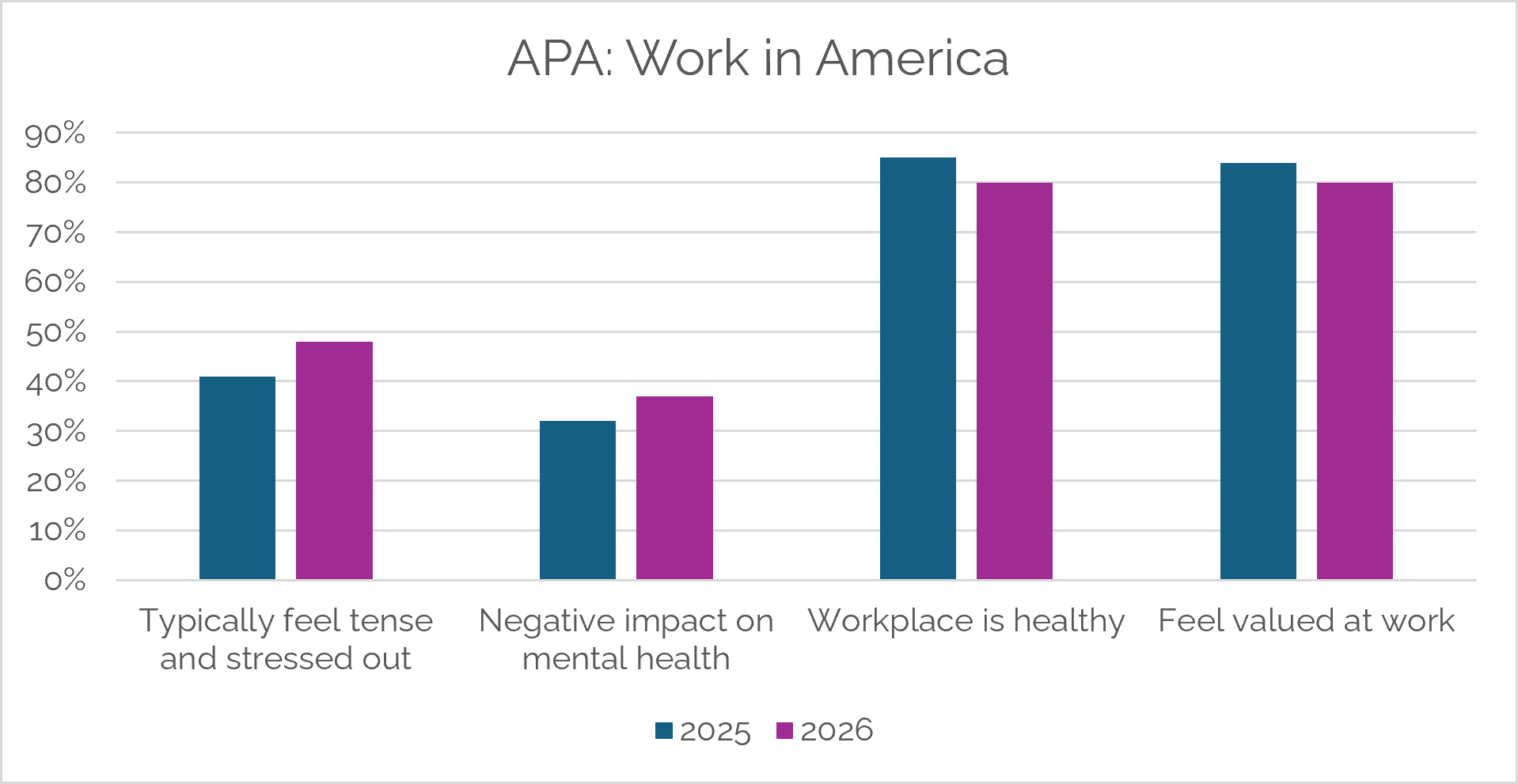
Workers today are more likely to see their workplace as unhealthy and report that they typically feel tense or stressed out – but there is something that managers can do to help.
That’s the findings of the recent American Psychological Association research surveys, Stress in America and Work in America, which shows a deterioration between 2025 and 2026.
There is something that can help
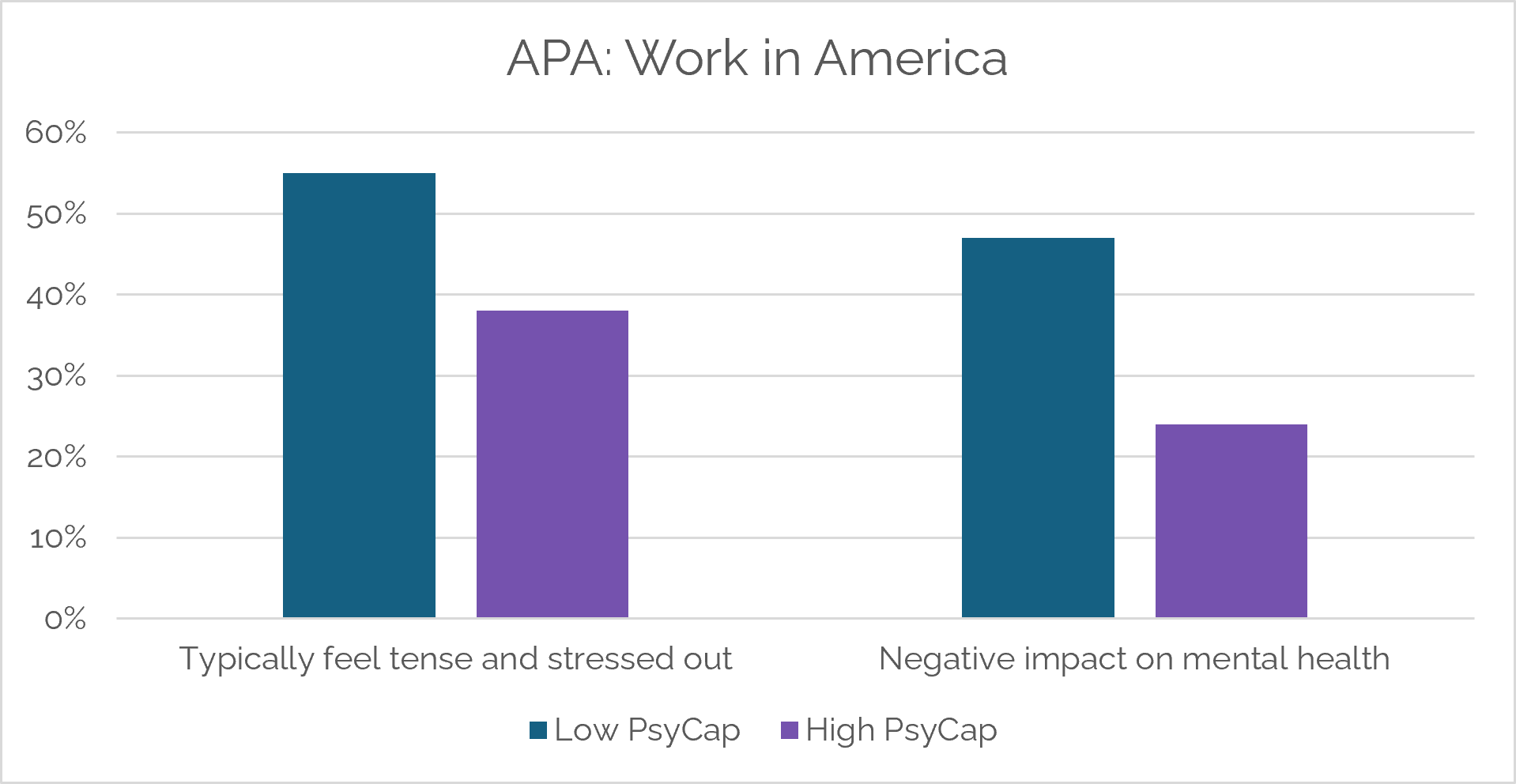
The APA analysed these findings and found a significant difference between workers grouped according to their level of ‘Psychological Capital’.
Only 38% of workers with high Psychological Capital reported feeling tense, compared with 48% of all workers and 55% of workers with low Psychological Capital.
Only 24% of workers with high Psychological Capital reported a negative impact on mental health, compared with 37% of all workers and 47% of workers with low Psychological Capital.
Workers with high Psychological Capital also reported lower rates of concern about losing their job and higher benefits of using AI in the workplace.
So, what is Psychological Capital?
Psychological Capital was developed by Fred Luthans and colleagues as an overarching term for four positive psychological factors: Hope, Efficacy, Resilience and Optimism.
The factors interact so that the total is more than the sum of the parts. Importantly, the factors are not fixed – through actions and choices we can increase Psychological Capital – for ourselves or our teams.
What sets psychological capital – and the HERO model – apart from many of the models you see in the popular management literature is that it is based on robust psychological research. It is a model worth investing in, if you will excuse the pun.
Let’s look at the HERO model in a bit more depth, and then we will explore the actions you can take to harness the positive psychology that underpins HERO to support your team and help them thrive during these disruptive times.
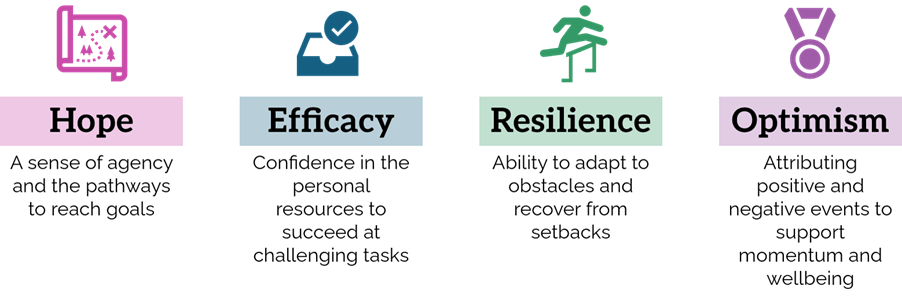
| Hope. This is not a naïve or unfounded aspiration. Hope is about having an appreciation of your agency to achieve your goals – coupled with the concrete reality of planning and structure so you can reach those goals. It is about both willpower and pathways. | Efficacy. We cannot truly succeed unless we believe in ourselves. Efficacy is appreciating our past successes, understanding our strengths and motivation, and knowing how we can harness these to help us with our current tasks and goals. |
| Resilience. Uncertainty, obstacles and setbacks are inevitable, but how we respond to them is vital. Resilience means building up our capabilities so that we can choose to react to challenges in ways that help us to make progress, and maximising our ability to recover and grow from adversity. | Optimism. Like hope, this is not naïve wishful thinking, it is rooted in reality. Optimism here is about focusing on positives, about correctly attributing successes and failures, appreciating what we can or cannot control and creating realistic positive future visions that we can use to help us plan and move forward. |
Build up Psychological Capital – for you and your team
Many researchers have shown how these four elements can be boosted by conscious action, and that they interact with each other and reinforce each other. You can see this in the ideas below, where some activities trigger psychological processes that can enhance multiple elements.
There are many more actions that researchers have shown to boost psychological capital, I’ve just chosen a few that should be easily achievable for you as an individual, or as a leader of others.
Hope
- Set goals thoughtfully. Set goals that link into the organisation’s big picture yet also can connect with an individual’s sense of personal purpose. Then break those goals into clear manageable targets. This sounds basic, but achieving smaller milestones in this way can create a sense of ownership, identity, and agency.
- Plan, and then plan for alternatives. Our first instinct is to plan and then get on with the action as soon as possible. Instead, spend time upfront thinking of alternative pathways you could take. Maybe one of these options will actually be a better solution, or maybe they will help you quickly pivot and adapt if your first plan runs into obstacles.
- Grant autonomy. Be clear about the parameters, the quality and any organisational-mandated processes, then give people as much freedom as possible to achieve the target in their own way – boosting their ownership and commitment.
- Celebrate progress, not just outcomes. To boost a sense of agency, acknowledge the small steps and the effort.
Efficacy
- Scale up success. Give people tasks that are achievable, yet still challenging, so that they can build up their confidence and skills and gain expertise.
- Identify relatable role models. Boost learning and familiarity through shadowing or observation of positive role models. Choose role models with comparable power and constraints to signal that their achievements can be replicated.
- Give developmental feedback. Provide timely, precise and actionable feedback so that people can learn, adapt and improve.
- Reflect on past successes. Consider what has worked well in the past, what was key to this, and what insights this generates for the current challenge.
Resilience
- Review to learn. Emphasise that setbacks and obstacles are a natural part of learning. Focus the individual reflection or group review on identifying lessons learned and considering how to enact them in the future, not on assigning or avoiding blame.
- Build in capacity and create space for recovery. Ensure there is sufficient capacity to achieve targets without exhaustion, and that people recognise the importance of taking time and space to recover and refresh.
- Reframe the challenge as an opportunity. Mentally reframing obstacles helps move them into the realm of rational problems to solve, where resources can be marshalled, and control (no matter how small) can be exercised. Review afterwards to identify growth and learning.
Optimism
- Clarify assumptions. Always check the foundations – what negative and positive assumptions are being made. Are they accurate in that specific context? Is the assumed causality, consequences and level of impact actually realistic?
- Look forward realistically. Taking time to envisage and describe a positive future state helps motivation and momentum – but it needs to be realistic, taking account of the actual resources and challenges.
- Know the limits of your control. Focus on the internal locus of control – take responsibility for the actions and decisions that are within your control, and appreciate what is outside your remit or power.
Harness the lessons of positive practices
At Formium Development we’ve always been focused on bringing lessons from positive psychology and positive organisational scholarship into managers’ toolkits.
Many of the ideas that are increasingly commonplace in today’s management best practice are derived from the pioneering work of thinkers like Seligman, Csikszentmihalyi, Peterson in positive psychology and Cameron, Dutton and Quinn in positive organisational scholarship.
Positive practices are highly effective in supporting individual and team performance, wellbeing, motivation and effectiveness.
If you want to know more about these ideas, and how you can harness them in the workplace, then book a free strategy call and we’ll share how you can move forward.