

“Tidy but shallow”
As a description of AI-produced content, these words stood out for me.
I’ve seen all too many workshop outlines and course designs that are clearly AI-produced.
They’re strong on structure, and they look fine.
But if you focus, you realise they’re just skimming the surface of the issue.
So, ‘tidy but shallow’ is a suitable description – coined by Dr Philippa Hardman in an incredibly interesting article on AI in L&D, where she explores recent research about AI and coding by Demirer, Musolff and Yang.
And Dr Hardman highlights the problem that I’m sure you’ve also experienced:
“AI is brilliant at producing the structured, plausible average… you get a flood of technically-fine, faintly hollow [L&D] content that reproduces common practice rather than best practice.”
If you want a plant to grow tall, don’t leave it in a small pot.
If you’re producing ‘tidy but shallow’ solutions, you’re not giving the learners the depth they need to really grow and flourish. And you won’t be solving the client’s problem.
So, what’s the answer?
When you’ve been commissioned to develop an L&D intervention – either from an in-house commissioner or an external client – you can avoid producing ‘tidy but shallow’ proposals by:
- Fully understanding the client’s needs and circumstances and incorporating this into your design.
- Seeking out high-quality examples, models and ideas that have a robust evidence base and which have not been undermined or discredited.
- Building in time in the workshop for practical connection: practice, debrief, discussion, sharing of experience, exploring points of view. Making connections is where facilitators shine – connecting ideas to organisational examples or realities, or connecting people together for insights. AI often downplays this element.
Six steps for robust L&D interventions
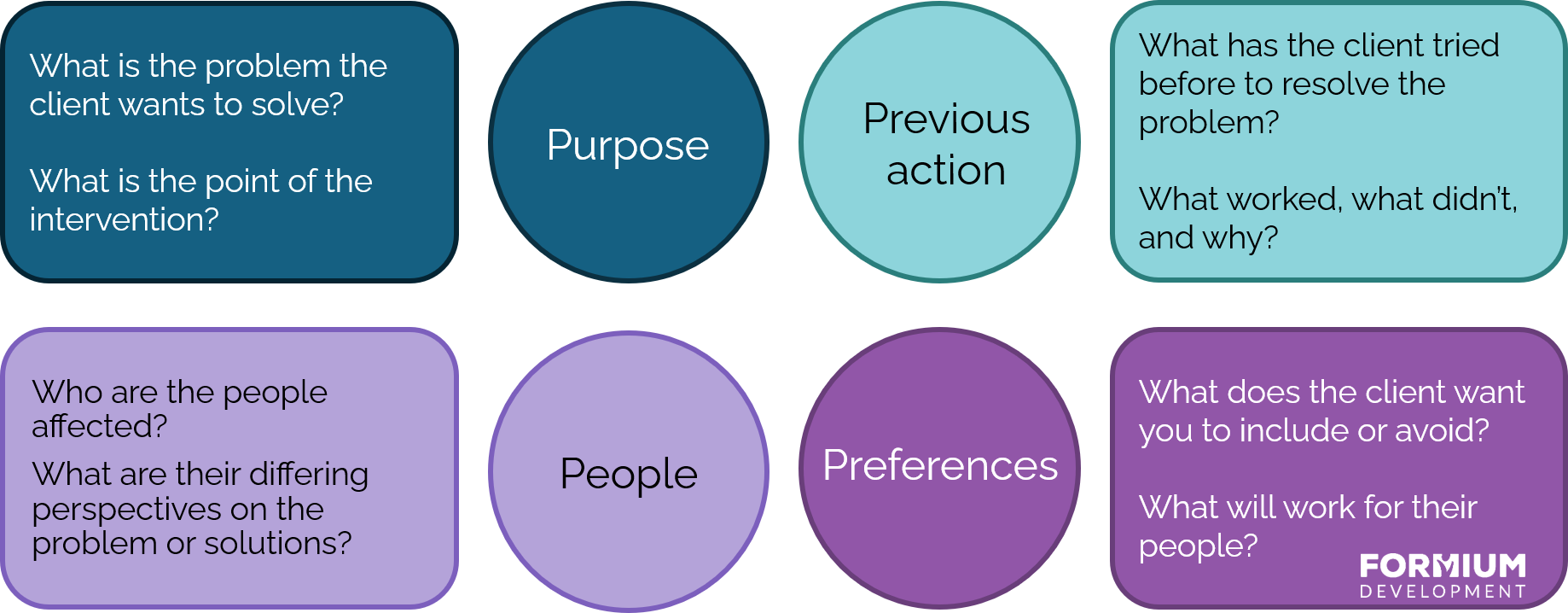
1. Use our 4P model to focus your initial engagement to uncover the depth of the commissioner’s issues, their challenges and their dynamics. Even if you are operating in-house, work through these four elements – Purpose, People, Previous action and Preferences – to help you extract the rich knowledge that you need so that you can provide a tailored solution that really addresses the problem and meets the commissioner’s needs.
2. Use this in-depth bespoke knowledge. Whether you’re using AI, search engines, or tapping into human knowledge and experience, use the rich contextual knowledge to frame your research questions. Search for ideas that specifically address the commissioner’s requirements, reality and restrictions – both individually and collectively.
3. Target your search. Take action to ensure that AI and/or search engines focus on reputable sources:
- You could use Google Scholar or other search tools focused on academic papers.
- Describe the types of source that you want, as part of your search terms or AI prompt.
- Through Google’s Preferred Sources option you can indicate the sources that you trust and want to see more of.
- Try Perplexity or other AI models that are designed to deliver high quality, research-based, results.
4. Follow the citations. Check the links and make sure you’re not being given a convincing answer that is built on a low-quality source.
5. Don’t stick with the first answer. Try the same search terms in a different search engine or an AI model. Or ask the original AI to answer the same question but using different sources.
6. Ask AI for the negative.
- Don’t just ask AI to provide a description and a link for the model, example or information. Request it to detail any known weaknesses or criticisms of the models it proposes.
- Instruct AI to undertake a Red Team review of the entire proposal and identify any limitations and weaknesses. This is particularly strong when you use a different AI.
Plant pots image initially created by Copilot and manipulated by the author