

Tag: learning and development

  • Move beyond “tidy but shallow” AI-produced L&D content

    Move beyond “tidy but shallow” AI-produced L&D content

    “Tidy but shallow”

    As a description of AI-produced content, these words stood out for me.

    I’ve seen all too many workshop outlines and course designs that are clearly AI-produced.

    They’re strong on structure, and they look fine.

    But if you focus, you realise they’re just skimming the surface of the issue.

    So, ‘tidy but shallow’ is a suitable description – coined by Dr Philippa Hardman in an incredibly interesting article on AI in L&D, where she explores recent research about AI and coding by Demirer, Musolff and Yang.

    And Dr Hardman highlights the problem that I’m sure you’ve also experienced:

    “AI is brilliant at producing the structured, plausible average… you get a flood of technically-fine, faintly hollow [L&D] content that reproduces common practice rather than best practice.”

    If you want a plant to grow tall, don’t leave it in a small pot.

    If you’re producing ‘tidy but shallow’ solutions, you’re not giving the learners the depth they need to really grow and flourish. And you won’t be solving the client’s problem.

    So, what’s the answer?

    When you’ve been commissioned to develop an L&D intervention – either from an in-house commissioner or an external client – you can avoid producing ‘tidy but shallow’ proposals by:

    • Fully understanding the client’s needs and circumstances and incorporating this into your design.
    • Seeking out high-quality examples, models and ideas that have a robust evidence base and which have not been undermined or discredited.
    • Building in time in the workshop for practical connection: practice, debrief, discussion, sharing of experience, exploring points of view. Making connections is where facilitators shine – connecting ideas to organisational examples or realities, or connecting people together for insights. AI often downplays this element.

    Six steps for robust L&D interventions

    1. Use our 4P model to focus your initial engagement to uncover the depth of the commissioner’s issues, their challenges and their dynamics. Even if you are operating in-house, work through these four elements – Purpose, People, Previous action and Preferences – to help you extract the rich knowledge that you need so that you can provide a tailored solution that really addresses the problem and meets the commissioner’s needs.
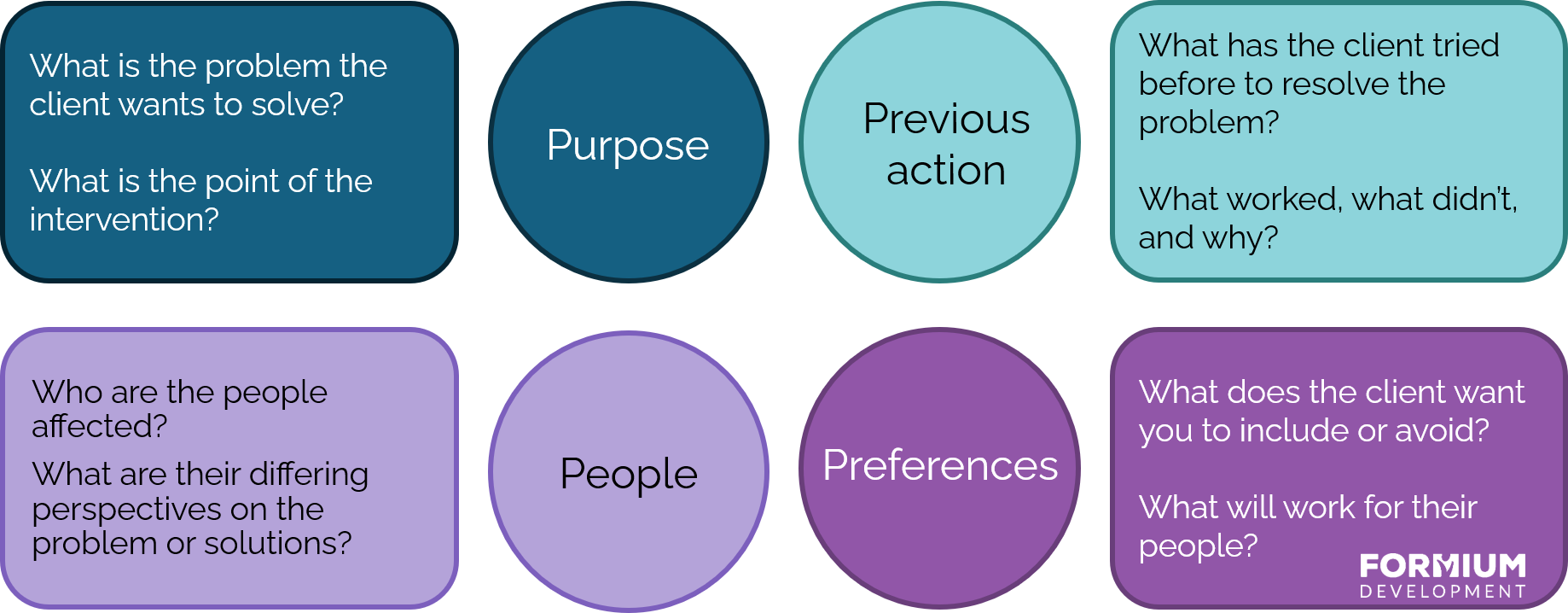
    Diagram of 4P: Purpose, People, 
Previous action, Preferences

    2. Use this in-depth bespoke knowledge. Whether you’re using AI, search engines, or tapping into human knowledge and experience, use the rich contextual knowledge to frame your research questions. Search for ideas that specifically address the commissioner’s requirements, reality and restrictions – both individually and collectively.

    3. Target your search. Take action to ensure that AI and/or search engines focus on reputable sources:

    • You could use Google Scholar or other search tools focused on academic papers.
    • Describe the types of source that you want, as part of your search terms or AI prompt.
    • Through Google’s Preferred Sources option you can indicate the sources that you trust and want to see more of.
    • Try Perplexity or other AI models that are designed to deliver high quality, research-based, results.

    4. Follow the citations. Check the links and make sure you’re not being given a convincing answer that is built on a low-quality source.

    5. Don’t stick with the first answer. Try the same search terms in a different search engine or an AI model. Or ask the original AI to answer the same question but using different sources.

    6. Ask AI for the negative.

    • Don’t just ask AI to provide a description and a link for the model, example or information. Request it to detail any known weaknesses or criticisms of the models it proposes.
    • Instruct AI to undertake a Red Team review of the entire proposal and identify any limitations and weaknesses. This is particularly strong when you use a different AI.

    Plant pots image initially created by Copilot and manipulated by the author

  • Ensuring performance improvement: a review of Learning Transfer at Work by Paul Matthews

    Ensuring performance improvement: a review of Learning Transfer at Work by Paul Matthews

    How do you ensure that learning and development activities generate the performance change you want? This question is at the heart of Paul Matthews’ readable and engaging book. A strength of the book is that the messages are equally appropriate for line managers supporting their team members to develop as they are for L&D professionals wanting to improve their value to the organisation.

    Paul Matthews gets to the heart of the matter – how do you ensure that learning is enacted in the workplace, and that this change in meaningful, lasting and effective? From this flow a range of other questions and ideas, with a common theme of learning and development as part of a workflow, in which a formal training workshop is one of many elements. This requires a strong and active partnership between staff member, line manager and L&D team throughout the learning intervention.

    The author adopts an unusual structure, the first 90 pages covering the theory and ideas in a traditional structure. He challenges why learning transfer activity is not undertaken, and explores elements of learning theory and behaviour change, including how memories form and how behaviours are triggered and adapted.

    The second 130 pages are structured as bullet points and short paragraphs – asking direct questions, providing external examples/contributions and presenting previously established ideas in a different format. This theory first, application/engagement second approach mirrors the flipped classroom approach he espouses.

    Key messages addressed include:

    Is training the right answer?

    Paul argues the importance of ‘performance consultancy’ – ensuring that all other opportunities to improve performance have been explored, and that the business benefits and sought outcomes are clearly articulated before a L&D solution is commissioned.

    You need a coalition

    To ensure successful behaviour change and performance improvement you need the involvement of line and senior managers before, during and after the intervention. You need to support and develop an organisational/team culture that supports development, mentorship and invests time in learning transfer activities such as coaching, reflection, on-the-job practice. You can gain buy-in through clarity around the exact business improvements that the programme will generate.

    It is a 4-day programme, not a workshop plus pre/post work

    Each workflow element is important and necessary in its own right, not an optional extra to the workshop. This message is as important for line managers as for the participants as it sets out the expectations that they will need to be involved in designing/supporting activities to embed the learning in the workplace, such as practising the new skills/behaviours in a safe setting.

    Begin with the end in mind

    What is the sought outcome of the learning activity? How will you know it has been successful? Paul Matthews challenges the attitude that successful L&D delivery is a well-attended workshop with positive feedback sheets, instead arguing that measurement of outcomes in terms of participant behaviour and business impact is fundamental to proving intervention effectiveness, as well as return on investment and value for the organisation.

    Workshop attendance does not equal behaviour change

    Exploration of how we learn, how we respond to triggers and form new habits is fundamental to designing a programme to generate the sought business outcomes. The exploration of Dr Ina Weinbauer-Heidel’s 12 Levers of Transfer Effectiveness provides readers with a clear framework to consider how far their L&D interventions support learning transfer.

    Paul Matthews’ selection and effective presentation of fascinating insights from a wide range of psychology and neuroscience research is at the heart of this book, and provides practitioners with a range of mechanisms to ensure that learning is embedded and enacted in the world outside the classroom.

    Buy the book from Amazon UK or Amazon USA

    For more articles like this, sign up to our newsletter:

  • The future of learning and development?

    The future of learning and development?

    The days are numbered for sheep-dip, classroom-based training courses, chosen by the L&D team, and often forgotten by the following week.

    Well, maybe not numbered, but the recent CIPD/ Towards Maturity report – Driving Performance and Productivity provides evidence that companies relying on old-fashioned models of learning and development are being outstripped by those embracing a learning approach that is more collaborative, multi-channel, integrated and accountable.

    The report’s message is that the top 10% of companies, for performance and productivity, are benefiting from using these modern methods – sometimes 3 times as much as the average, and massively above those in the lowest 25%.

    Here’s a few key findings:

    • 76% of the ‘Top Deck’ (highest performing 10%) are confident in incorporating the use of new media in learning design (33% average, 14% bottom quartile)
    • 62% routinely collect information on the extent to which learning points have been understood (30% average, 5% bottom quartile)
    • 71% collect information from learners on the extent to which learning points have been applied at work (24% average, 2% bottom quartile)
    • 73% involve learners in the design of the most appropriate learning solution (25% average, 1% bottom quartile)

    So the challenge to L&D teams is – how can you harness these approaches so that your company benefits? How can you incorporate these ideas into your strategies, and how to shift the culture towards collaboration, individual accountability for learning, and greater integration into strategic and operational needs?

    The report provides compelling ROI evidence that I’m sure will help those arguing for greater resources or the input from colleagues. But the important takeaway for me is the change management and strategic thinking that will be required to embed these ideas. It is about changing the perception of learning and development from a top-down obligation to a more bottom-up opportunity to thrive.


    Eszter Molnar Mills is a strength-based leadership and organisation development specialist and founder of Formium Development. She helps organisations and individuals reach enhanced performance by reflecting on what works, and developing skills and strategies for improvement. Eszter leads our learning partnership work; contact us to discuss how we can support your learning and development strategy.