
What if I told you that when you are in a conversation, you will be adopting one of 4 structural positions?
That’s one of the elements of Structural Dynamics – a model of group dynamics, proposed by David Kantor for use by coaches and leaders.
It’s a model I’ve used with senior teams to help them analyse how they work together, to identify trends at individual and group levels, and to improve how they respond to high-stakes situations.
Kantor developed the model based on his work as a therapist observing thousands of hours of family interactions. From these he identified underlying structures which affect the quality and outcomes of all conversations.
Using the model doesn’t require you to go digging deep into people’s histories, but just to appreciate that the way people act is a response to individual drivers and incentives that may be very deep rooted.
It’s a model ideally suited to team leaders, coaches, mentors, and managers – anyone for whom communication is key.
Let’s look at the model first, and then how you can use it.
1. Action stances – the four player model
Probably the best known element of Structural Dynamics is the idea that in a conversation, regardless of the actual content of your words, you are either taking initiative (Move), agreeing and developing that idea (Follow) challenging the idea (Oppose) or making an observation abut the conversation itself (Bystand).
Kantor proposes that all elements are necessary for a productive conversation – for instance, without opposition the wrong decision may be made, and without anyone following, then nothing will get done.
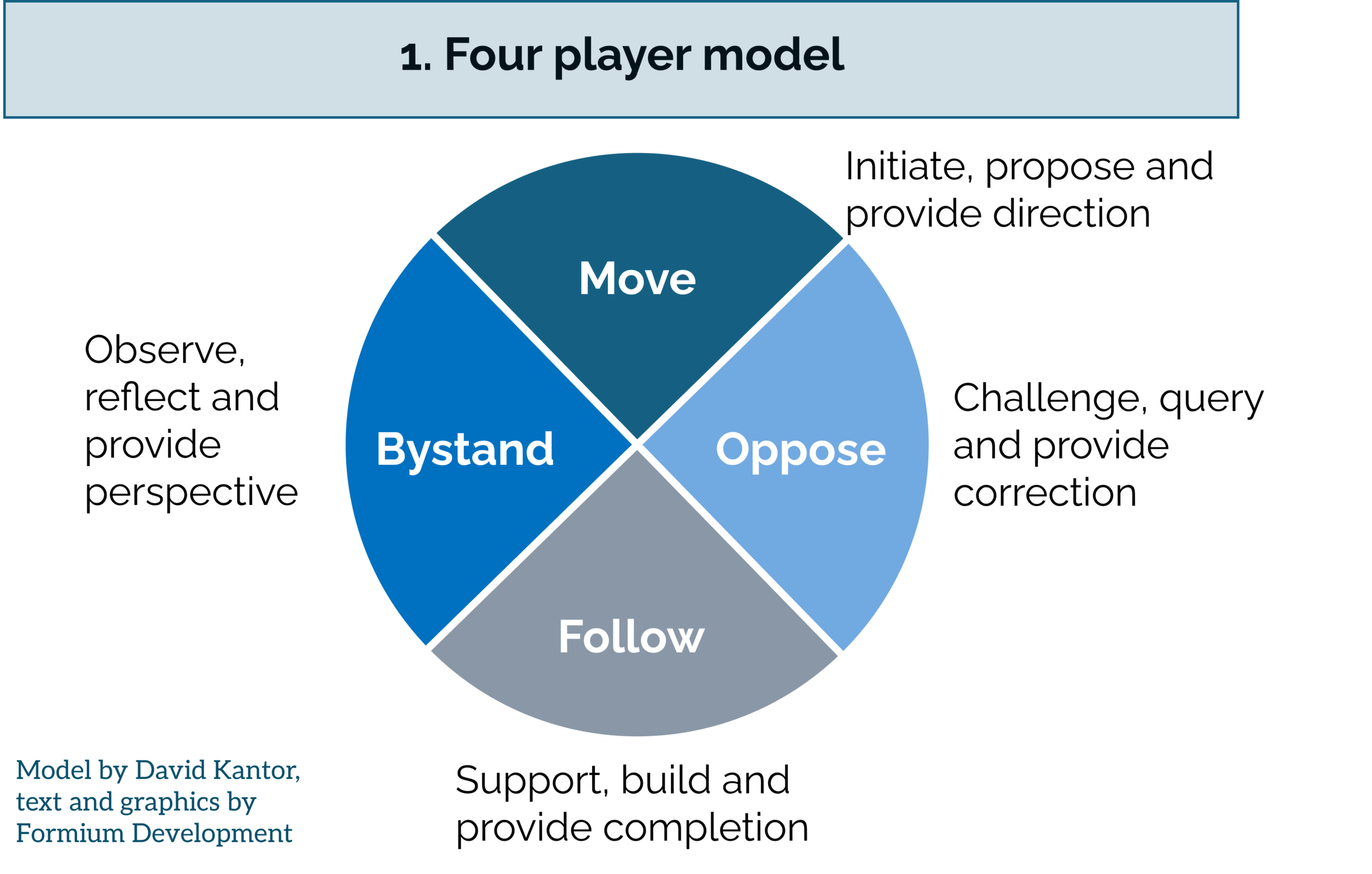
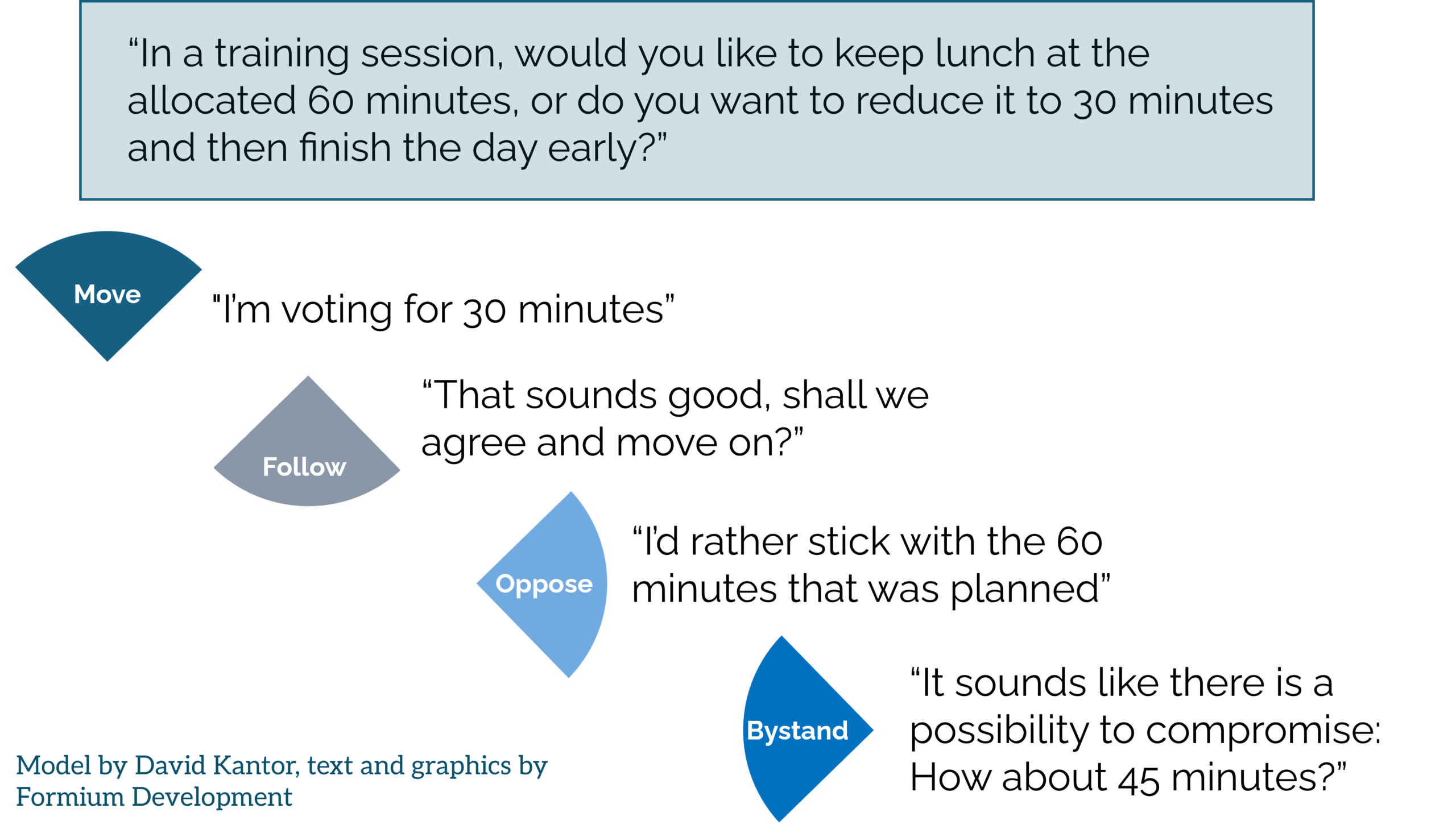
So what does this look like in reality? Well, here is a simple conversation that follows the option of reducing the allocated lunch time in a training session. You can see how each of the four players respond.
2. Communication domains
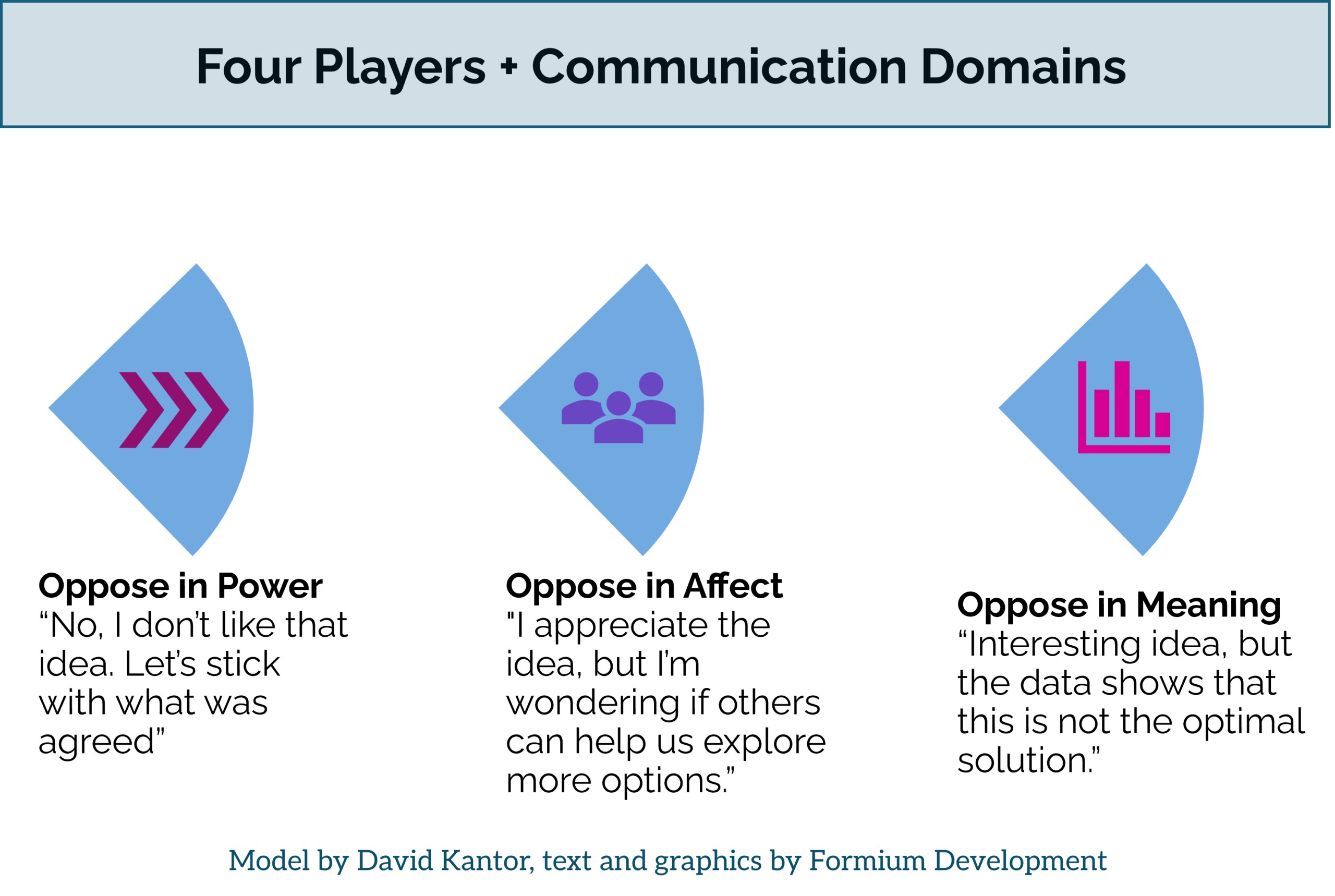
Underneath the action stances are three communication domains, which determine the types of language you use, and the subject of your concern. Kantor argues that miscommunication is often a result of people being in different communication domains when they are speaking.
For example, someone who is focused on actually making a decision and taking action (the Power domain) might get frustrated talking to someone who wants to talk about how the outcome of the decision will impact on people and connections (the Affect domain), or another person who is more interested in the evidence and hypothesis for the decision, and how it aligns with values (the Meaning domain).
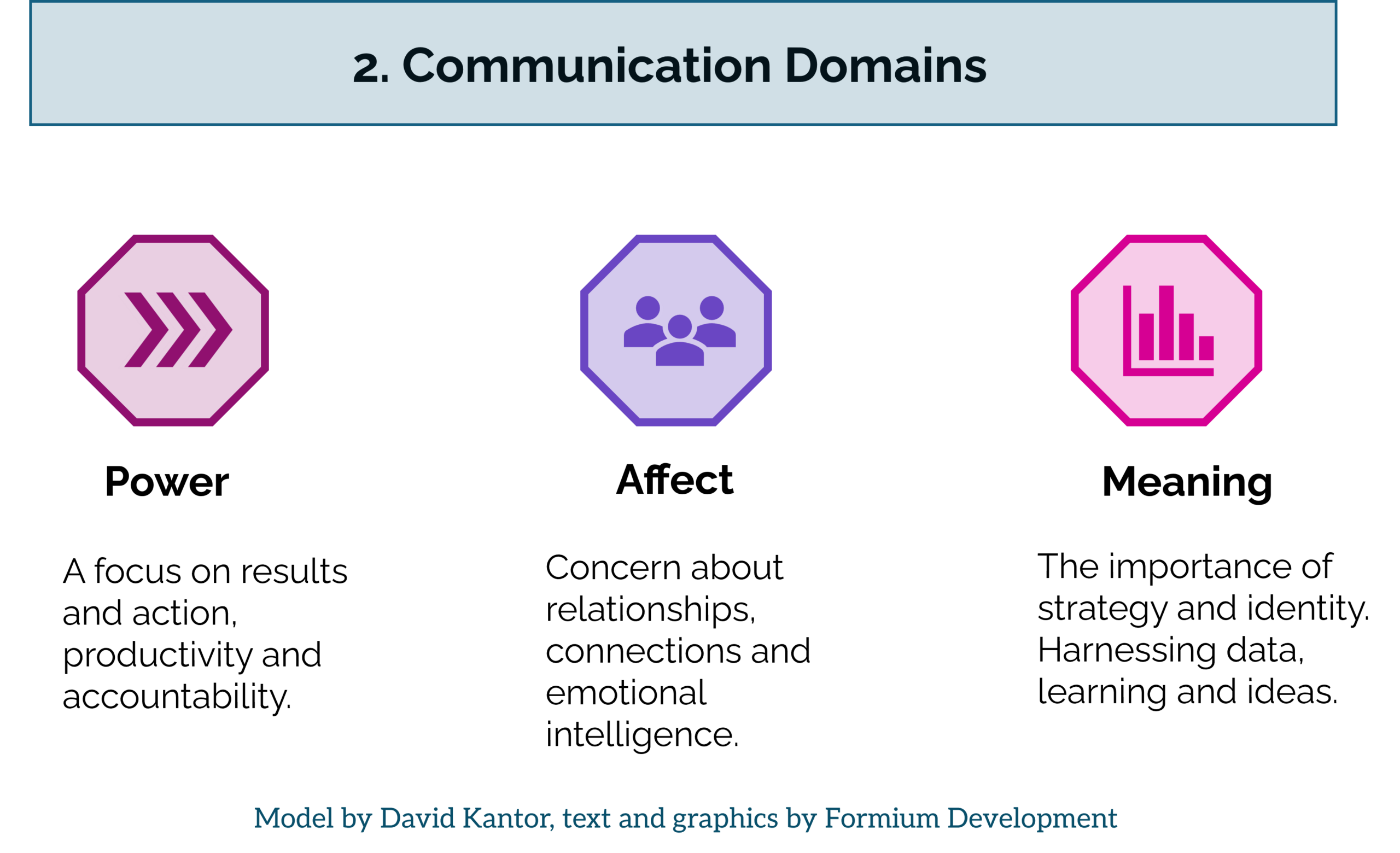
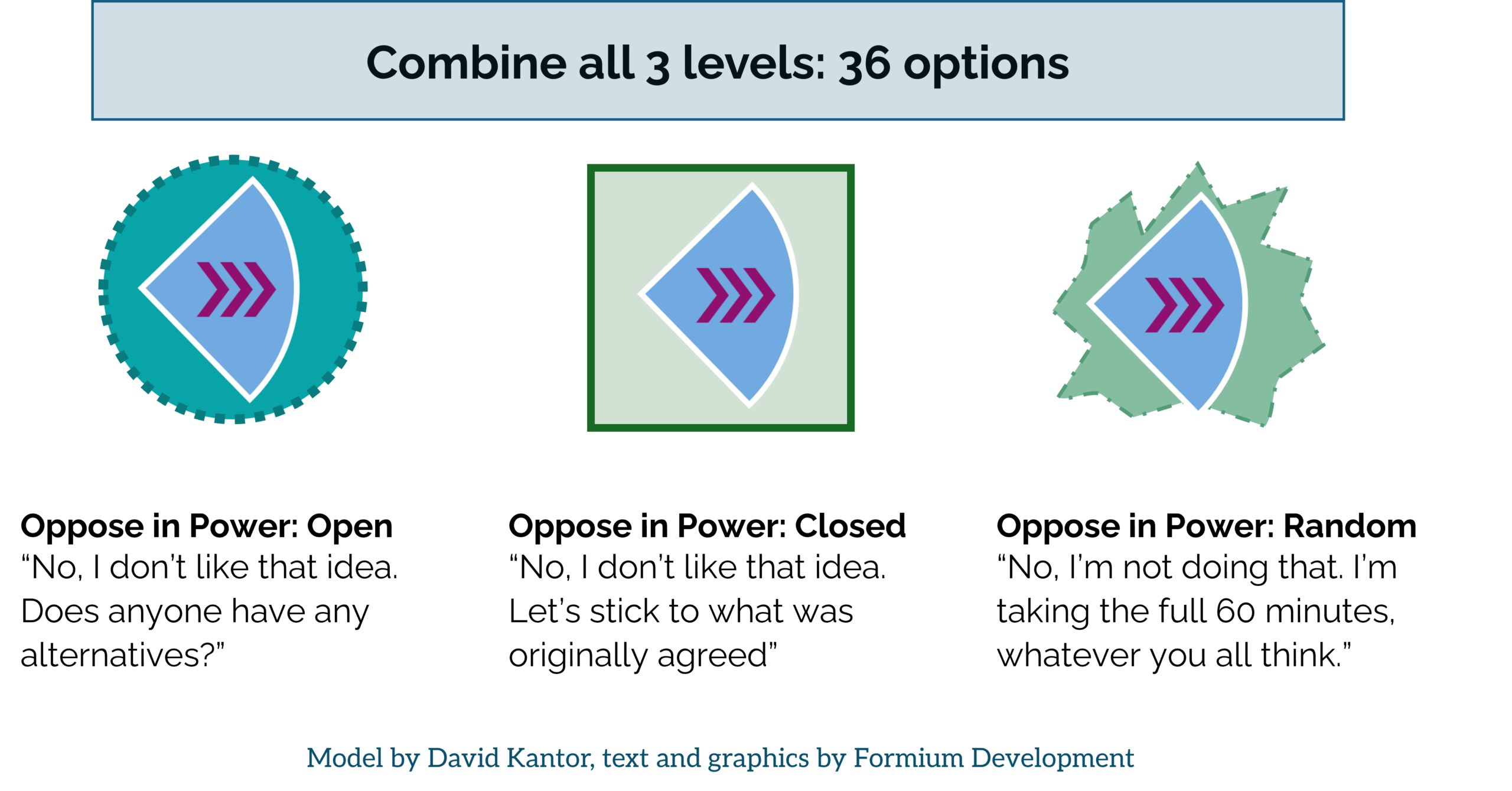
The different levels of Kantor’s model operate as layers – so an ‘oppose’ response will be different according to which communication domain that person favours.
3. Operating systems
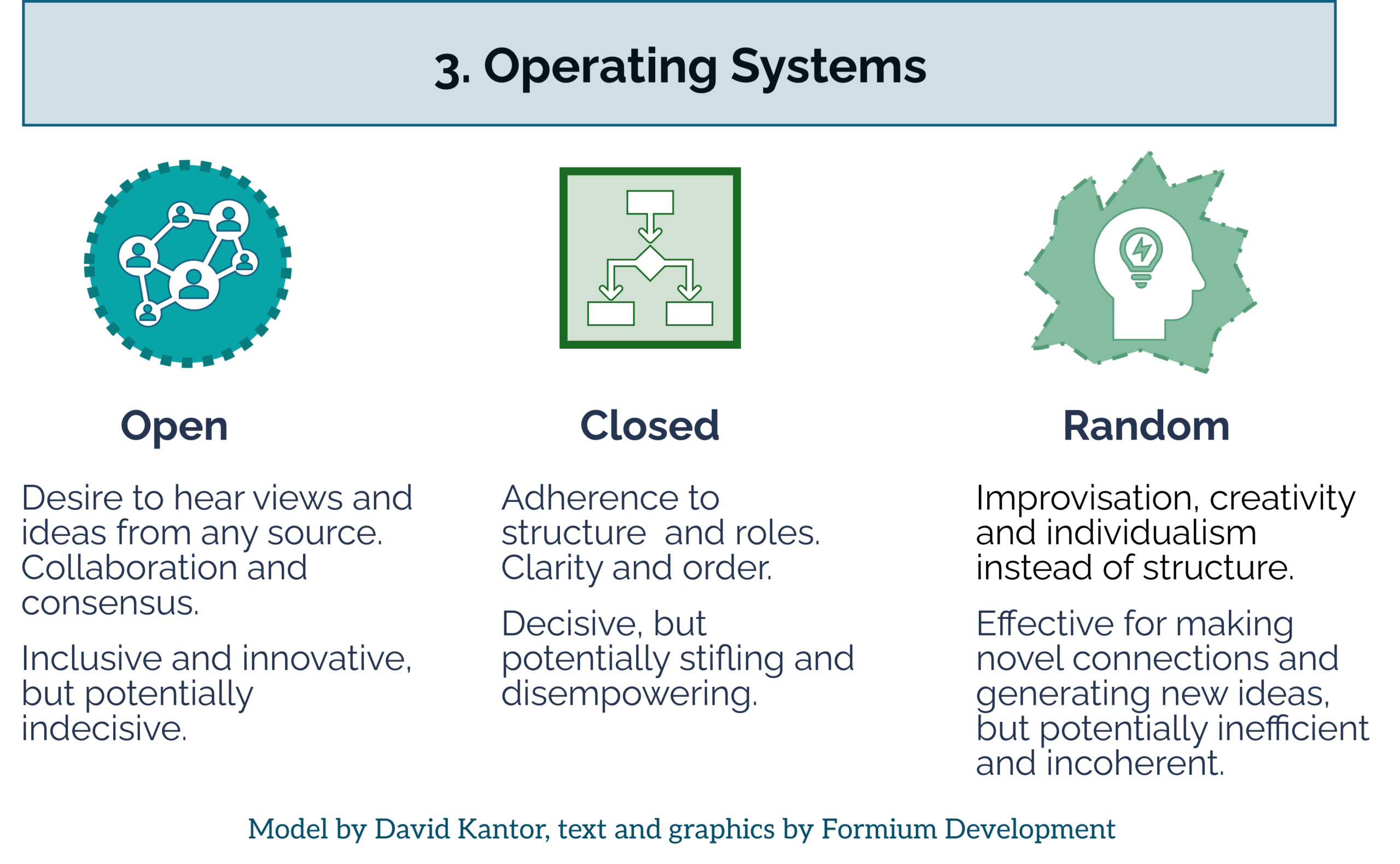
The deepest level of structures affecting our conversations are the three operating systems, which define our approach to engaging with ideas and making decisions. The Closed operating model is chosen by someone who prefers a structured approach that respects hierarchies, whereas someone who wants to consult more widely uses an Open system. Finally, someone who is more focussed on individual choice and improvisation can be said to be in the Random operating system.
This creates 36 possible combinations:
4. Shared characteristics
All levels of the model share certain characteristics:
- all approaches are equally morally valid; all have a purpose
- people have a preference which often acts as their default
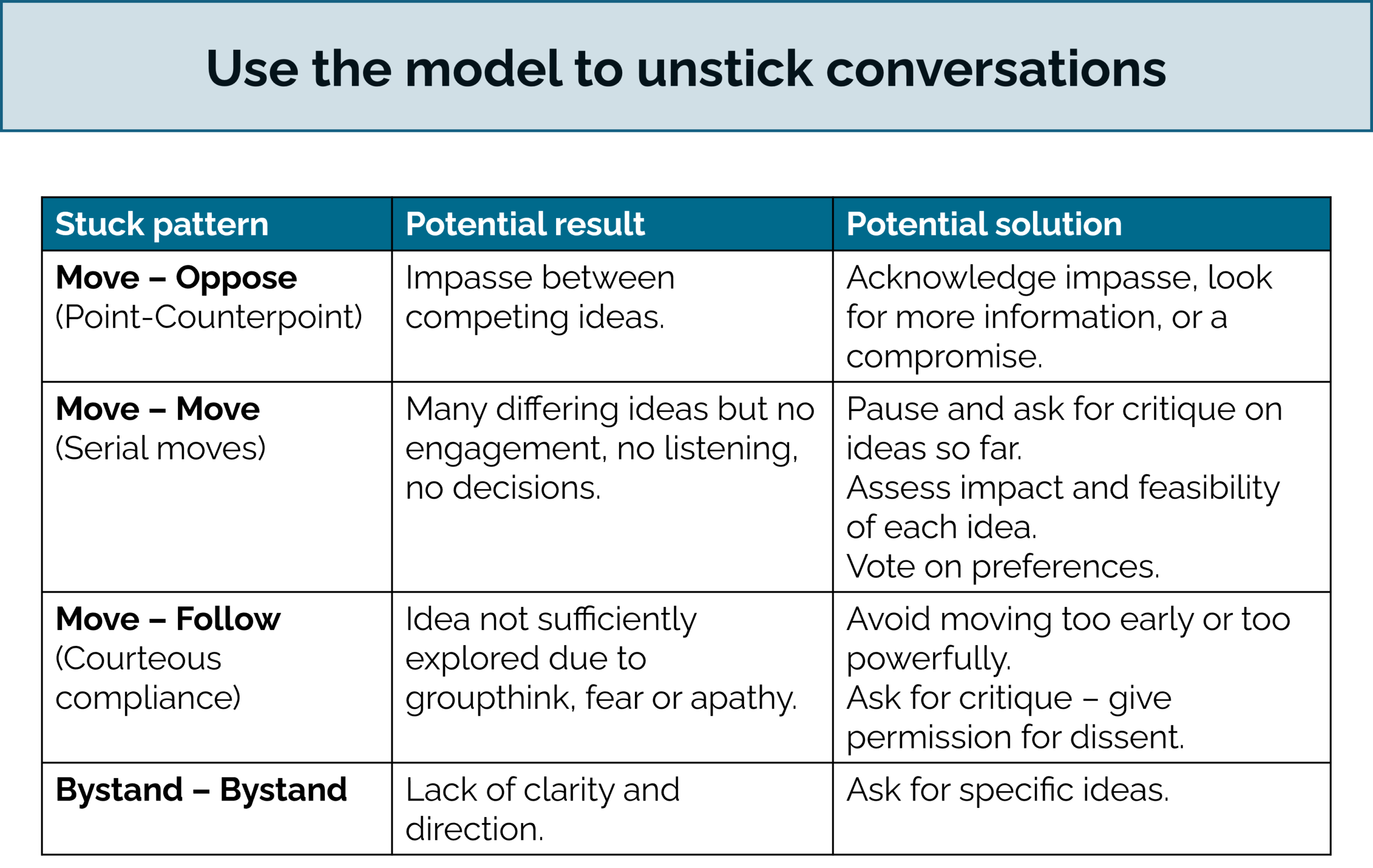
- people can get stuck using an approach that is sub-optimal for the situation
- conflict and misunderstanding is the result of using a different approach to the other people you are talking with.
5. How coaches and leaders can use this model
- Understand your own preferences. There are multiple ways of assessing yourself, but start with a simple reflection on each level – which of these do you think most sounds like you? We have had great success using a simple set of self-assessment questions to determine preferences.
- Identify other people’s preferences. Can you spot patterns or mismatches in approach that lead to miscommunication and frustrations?
- Flex your approach. When you spot a mismatch, consider changing your language, items of focus or decision-making approach so that you can connect better with the other person.
- Invite them to try a different approach. Try to break stuck patterns: for example, if you have someone who tends towards following rather than moving, then ask them for their opinions. Alternatively, you could acknowledge that another person’s interest in building a wider consensus is valid (the affect domain, open operating model), but you now need to focus on structured decision-making (the power domain, closed operating model).
- Team analysis. Look at the patterns and approaches within a team to identify the group dynamics. Look for behaviours and approaches that are over-played, and others that are under-represented. Use the language of the model to help people discuss their communication patterns and seek better ways of collaborating.
6. Operating under pressure
There is one further level Kantor proposed – how we react with increasing levels of pressure.
He proposed that within a conflict where someone is viewed as an outsider, people are likely to transition from using the language of the communication domains – Power, Affect and Meaning – to that of a Prosecutor, Advocate or Adjudicator.
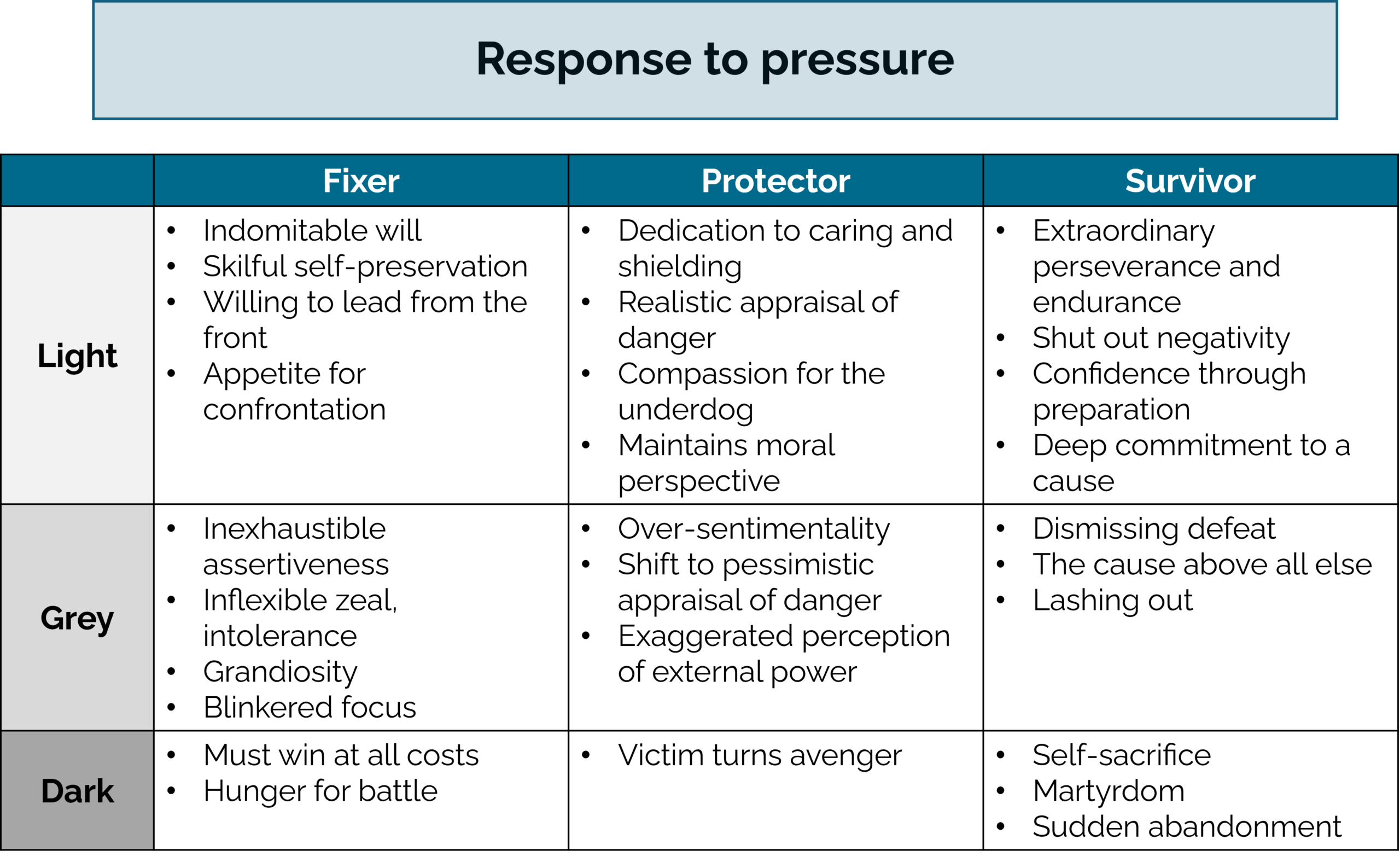
And, when faced with a situation of increased pressure or crisis, people tend to favour one of the ‘Heroic modes’ – Fixer, Protector and Survivor.
Look in the diagram below and you’ll see that each of those heroic modes has largely positive factors (light zone), but as the pressure increases, these positives become more destructive (the grey and dark zones).
Kantor stressed this was not necessarily a linear progression from default Communication Domain to default Heroic mode, but certainly a tendency.
Leaders can use this level of the model:
- Be aware of your default heroic mode and especially the consequences of overplaying it.
- Understand that other people are operating in other modes – don’t expect them to behave like you. They have reasons for reacting as they do.
- Change your mode to engage others where they are.
- Changing mode helps you avoid boiling over into the grey and dark side of your default mode.
7. Get your team working together more productively and smoothly
Structural dynamics is one of the many tools I use to help leaders understand the tensions, blockages and boosters that operate in their team.
I have used self-assessment questionnaires to help teams identify their preferences, provided training and resources so team members can try and spot patterns and preferences, and facilitated discussions about improving communication and decision-making.
One of the key benefits of using a model like this is the shared language that it gives teams, so they can analyse their interactions and spot patterns or obstacles. Whether you agree with the model or not, it gives you a way to explore your communication.
By taking time to scrutinise how team members communicate with each other, how they work together, and how they interact, managers can develop insights that will help them boost performance, reduce conflict and enhance wellbeing and morale.
8. Use this with your coaching or mentoring clients
Coaches and mentors can use the Kantor approach, and our self-assessment, to improve their understanding of where their client is coming from, what matters to them, and what might be underneath their challenges.
Coaches can also benefit by introducing their client to the model, and inviting them to use it when assessing conflicts and obstacles.
Like the managers mentioned above, coaches and mentors can benefit by having clear coherent language and terms that they can use to discuss communication concepts.
If you’re interested in hearing more about how you can unlock these benefits for your team, or coaching clients, click the button and get in touch.