

We are living in a period of unprecedented disruptive change – political, technological, environmental and economic – and managers and leaders are facing novel challenges every day.
Against this backdrop I thought I’d share two insights on surviving change from unusual sources.
1. In the face of disruptive technology, find or create opportunities that align with your skills and strengths
In a conference a few months ago, Egle Vinauskaite compared the position of Learning and Development teams facing AI to that of eighteenth century artisan weavers facing the newly invented power loom – disruptive technology that threatened their whole way of life.
But at a cinema in London I recently saw a great example of how people can adapt to the threat of new technology – from 1920s Japan.
The arrival of cinema threatened the livelihood of the traditional Japanese storytellers who would captivate large audiences in theatres. Anticipating diminishing crowds, the storytellers took action to embed themselves into the disruptive technology by creating the role of benshi.
To accompany the silent images, a live storyteller – the benshi – stood at the side of the cinema screen. They told viewers the story of what was happening on the screen, bringing it to life using their traditional skills to provide different voices, and to add emotion and drama.
Importantly, the benshi was not a narrator of the director’s script: instead, they would interpret the film and tell their own story of what viewers could see. They toured cinemas with ‘their’ film and were stars in their own right: as each screening was a unique event, cinema-goers would go see a film based on which benshi was playing, not which actor was in the film.
So, the benshi adapted their storytelling skills, reputation and traditions to embrace, and even control, this new technology. Admittedly, the arrival of talking cinema meant this was a short-lived mass phenomena, though some benshi were able to become talking movie stars in their own right.

2. Think creatively to make an imperfect situation into something entirely different
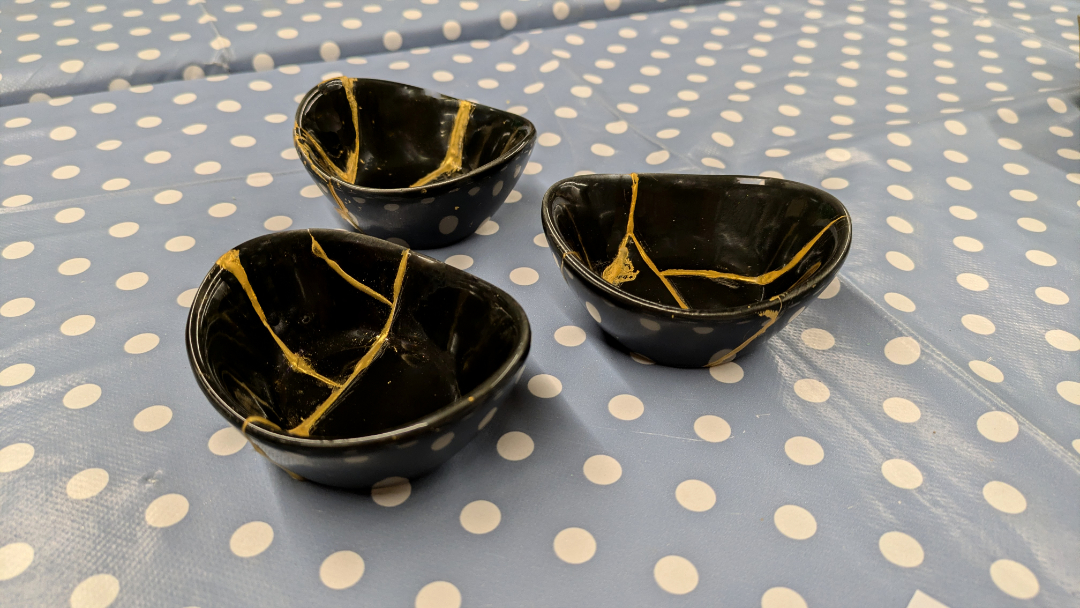
More well known than benshi is the Japanese tradition of kintsugi, which I tried recently in a workshop with the wonderful London-based community arts organisation Art4Space.
In most countries, a cracked vase or plate would usually be discarded. Even if it could be mended, the initial perfection would be marred by an unsightly scar.
But, tapping into a philosophy that embraces impermanence and change, fifteenth century Japanese artisans developed the art of working with the flaws. They filled the voids with gold to create a new, enhanced, object – one that was not discarded, disguised or seen as disfigured, but instead proudly told its story.
So what are the lessons for us today?
The story of benshi suggests we should be looking at ways of using our existing strengths and skills to find a new role within the disruptive change. It may be short-lived, but even a transitional role can help us adapt to the new reality, and be ready to change again.
Kintsugi suggests we focus on mindset – we need to accept that what we had until now has gone. The change is permanent, but instead of discarding what we have built up entirely, or seeking to continue with flaws and cracks clearly visible, we can choose to make something of our changed circumstances that is unique, that has value in its own right, and which echoes our journey.